BJP’s Haryana state assembly win has sent a wave of optimism not only among the BJP supporters; but the entire right wing nationalist constituency. A strong feeling of euphoria has spread among the group with a view that BJP has finally found the winning formula.
In my view this victory has been as serendipitous for BJP as the 2024 Lok Sabha election results were for Congress. In both the cases pollsters were found licking dust and the looser were celebrating while winners were losers. I am conscious that my statements need bigger explanation.
First reason for my assertion is that in both the cases, the victory or loss for the two sides were not a result of strong support or strong opposition for either side – the result was an outcome of inner party feud, overconfidence and ignorance of the electorates’ wishes. As much as BJP took UP’s electorate lightly and left them literally on the benevolence of Ram Lalla, Congress ignored Haryana’s electorates’ on the mercy of Jat and other OBC consolidation. An analysis of victory or loss margins of candidates will make this very clear. So in both the cases, the lesson for loosing side is to get their acts together and go develop wider connect with the people and listen to them.
Second point to mention here is that in both the cases confident party depended solely on one issue which generated extreme confidence among their rank and file. In case of Lok Sabha election BJP were confident that Ram Lalla will sail them through a thumping victory and in case of Haryana election Congress was confident that the caste census along with farmers’ discontent and Agniveer issues were brahmastras.┬а
Third point to mention here is that both the parties have to learn a quick lesson and that is – they are national parties and whenever there will be disconnect between the national leadership and local leadership in terms issues and agenda, people will give a confused mandate. In a run up to the Lok Sabha election, BJP tried to divide Muslim voters with their appeasement ideas and similarly during Haryana elections Congress made confusing statements on reservation and Agniveer.
Both the parties must realise that they are national parties based on ideologies and it is better for them to stick to their ideologies and not confuse electorates’. BJP is the sole Hindu nationalist party who is seen by the vast Hindu population as saviours of Hindu faith. They should carry the ideology of promoting the Hindu civilization. Congress is seen as a party with Secular ideology┬а and they should remain secular – within their meaning of this word.
It is too early for BJP to celebrate. The real test of their winning formula will be proven in Maharashtra and Jharkhand elections and later in West Bengal elections.
The recent Indian national election results revealed a significant setback for the Bharatiya Janata Party (BJP), sparking numerous political debates and analyses. While various theories attempt to explain the unexpected outcome, this article focuses on a fundamental marketing and branding mistake by the BJP. Drawing parallels from marketing principles, it becomes evident that BJP’s errors are akin to mistakes any marketer would avoid, even in the most basic management courses.
The Political Marketplace Analogy
In the political marketplace, parties operate like firms, with their ideologies serving as products and citizens as customers. Voters choose political parties based on their ideologies, authorizing them to govern. A political brand’s personalityтАФits communication of values and beliefs through visual cues, messaging, and actionsтАФis crucial for emotional connection and loyalty.
Established Brands
Brand RSS
Brand RSS is characterized by honesty, selflessness, nationalism, and its role as a Hindu organization. It is seen as the protector of Hindu civilization, with a reputation built by dedicated pracharaks living modestly for the cause. This brand has deeply influenced its child brands, including BJP. .
Brand BJP
Brand BJP embodies ideology-driven principles, honesty, selflessness, nationalism, and a right-wing stance. Among detractors, it is viewed as anti-Muslim but never corrupt or self-seeking. These traits are inherited from Brand RSS and reinforced through BJP’s history, including the origin story and notable events like the Rath Yatra and Vajpayee’s principled stand in parliament.
Brand Modi
Brand Modi is a grandchild of Brand RSS, representing hard work, selflessness, and Hindu nationalism. Modi’s rise to power was supported by his association with RSS and BJP, and his image aligns with the civilizational renaissance advocated by these brands.
Analysis of Election Performance
Despite its strong brand foundation, BJP’s recent election performance fell short of expectations, causing internal and external political turmoil. Analyzing the situation reveals critical branding and marketing mistakes.
Dissociative Conflict J.P. Nadda’s statement asserting BJP’s independence from RSS created a dissociative conflict. This move was akin to Switzerland denying its European identity or Dettol abandoning its antiseptic image. Such statements confuse the electorate, undermining the symbiotic relationship between BJP and RSS and leading to electoral setbacks.
Personality Distortion
Political Machinations in Maharashtra: The events leading to Shinde becoming CM and Ajit Pawar as Deputy CM contradicted BJP’s principled image, likened to Vajpayee’s principled resignation.
Inclusion of R.K. Singh: Despite his “Saffron Terror” remarks, his induction into BJP and subsequent ministerial position alienated RSS cadres and BJP workers.
Political Machinations in UP: The inclusion of Rajbhar and others further distorted BJP’s ideological consistency.
Inducting Outsiders: Allocating tickets to non-BJP members diluted party loyalty and brand consistency.
RSS’s Shift in Positioning RSS’s attempts to soften its Hindutva stance confused its core supporters. Statements from the RSS chief about building bridges with Muslims and emphasizing commonalities between Hindus and Muslims diluted the hardcore Hindutva ideology, leading to confusion among RSS and BJP cadres.
Overemphasis on Brand Modi BJP’s strategy to elevate Brand Modi above Brand BJP and Brand RSS conflicted with the selfless worker image of RSS and BJP. Slogans like “Modi Ki Guarantee” and “Modi Hai to Mumkin Hai” contradicted the core principles of selflessness and ideological work, alienating traditional supporters.
Misguided Slogan The slogan “Abki Bar 400 Par” was inconsistent with the selfless work ethos of RSS, BJP, and Brand Modi. It projected a power-seeking image, confusing voters and clashing with the established brand personality.
Changing commitment from core Hindutva agenda – Several times during last 10 years, BJP has been seen as moving away from core Hindutva agenda and not supporting the core supporters. It was evident at the time of Nupur Sharma’s resignation or Bengal violence against the BJP political workers.
Conclusion
BJP’s poor election performance can be attributed to fundamental branding errors, particularly dissociative conflicts and personality distortions. Maintaining brand personality and consistency is vital for political success. The lessons from this election underscore the importance of coherent branding strategies in political campaigns, ensuring clear and consistent messaging to the electorate. BJP must revisit basic marketing principles and realign its branding strategies to regain voter trust and loyalty.
тАЬAfter 500 years, even the grand Ram Temple at Ayodhya could not unite 1.2 billion Hindus. Instead it successfully united 180 million Muslims against HindusтАЭ.
Above is a general sentiment after 2024 election results. Question is why has the temple not been able to unite the Hindus.
The awakening conversation
Last few weeks I have been travelling extensively in rural Bihar. One i actually gave me one possible and most probable answer for this intriguing question. The incident deserves few paragraphs.
Nanmum (name changed) has been associated with my family since his childhood. His family has been toiling on our village field for last three generations. Whether this arrangement will continue after Nanmum is uncertain because neither Nanmun’s children live in village any more, nor our family has anyone living in our village anymore. But that is not the point of discussion here. I want to talk about my discussion with Nanmun when he took me to the local village “Brahma Sthan” the centre of faith for the entire village. Just after I arrived in my home, he opened and cleaned the house and made it comfortable for me. He asked me to wash up and pray to our “bhagwati” first. Bhagwati is our family deity and one of the rooms in our house is dedicated for her. Anyone coming home first goes and bows to Bhagwati.┬а┬а┬а
After praying to the Bhagwati, Nanmun asked me to come with him to the “Brahma Sthan” and pay my prayers to “Brahma baba” and “Mahavira Ji”. I followed Nanmun’s advice. But one thing I noticed distinctly. He did not come inside “Bhagwati’s” room in my house, neither he came inside “Brahma Sthan”. He did pray from outside. When I asked him, his answer was, “we are lower caste so we pray from outside the pedestal”. I was not surprised and I asked him to come inside; but he did not. During the course of day when he was taking me around my fields, I came to know that he has been pure vegetarian for last twenty years, following strict schedules of eating and prayer and has been follower of Kabirpanth. He has a guru from Kabirpanth about 100 Kilometers away and he regularly visits the Guru.
“Jati” created a distant relationship with core faith
The whole episode opened my eyes. It seemed to give me some answers to the question that I was searching for a long time. Few things were very clear. Firstly, the roots of Sanatan thought was very strong that even in the face of discrimation and ostracization the connection to the core philosophy always remained. Nanmun and his family have been exposed to Islam for three generations now in my village and adjoining areas. Few of his caste members had converted to Islam two generations ago and had set up a small Muslim hamlet outside our village. He has remained strongly attached to the core of Sanatan. The temple has not been able to represent the centre of his faith because his caste people have not been allowed to enter temples for long time. After several generations, that has become a ritual which no one wants to break and that is why when I asked him to come inside the Bhagwati room or inside the temple, he stayed away. However, he has found the same strength of faith in Kabeer panthi teachings where he is able to find his spiritual expression more freely and openly.
Large section of population of our country in North India experienced temple as centre of their faith only from a distance. That is why a temple movement makes them happy, but is is not able to become a strong emotional linkage.
“Jati” can be eradicated through temples very quickly
This needs to be reformed from within Hindu society. In my opinion following can be the fastest way to bring this reform.
.
1. Legal changes to free temples from government control and that temples should manage their own affairs just like Church, Gurudwara, Mosques are allowed to do.
2. Government should farme rules for management and governance of temples by the local community.
3. “Pujari” should considered as a skill in the same was a there any other skill
4. Government should enable courses of “Agamas” to certify Pujaris
5. “Pujaris’ should be appointed by the temple committees based on the knowledge of Agamas and shastras and not based on the born caste.
6. Of course, entry and exist can not be restricted based on born caste, however local temples should frame rules of entry / exist based on the specific nature and purpose of deity
If we do this, we will unleash the true temple economy which will be all inclusive and centre of Sanatan faith.
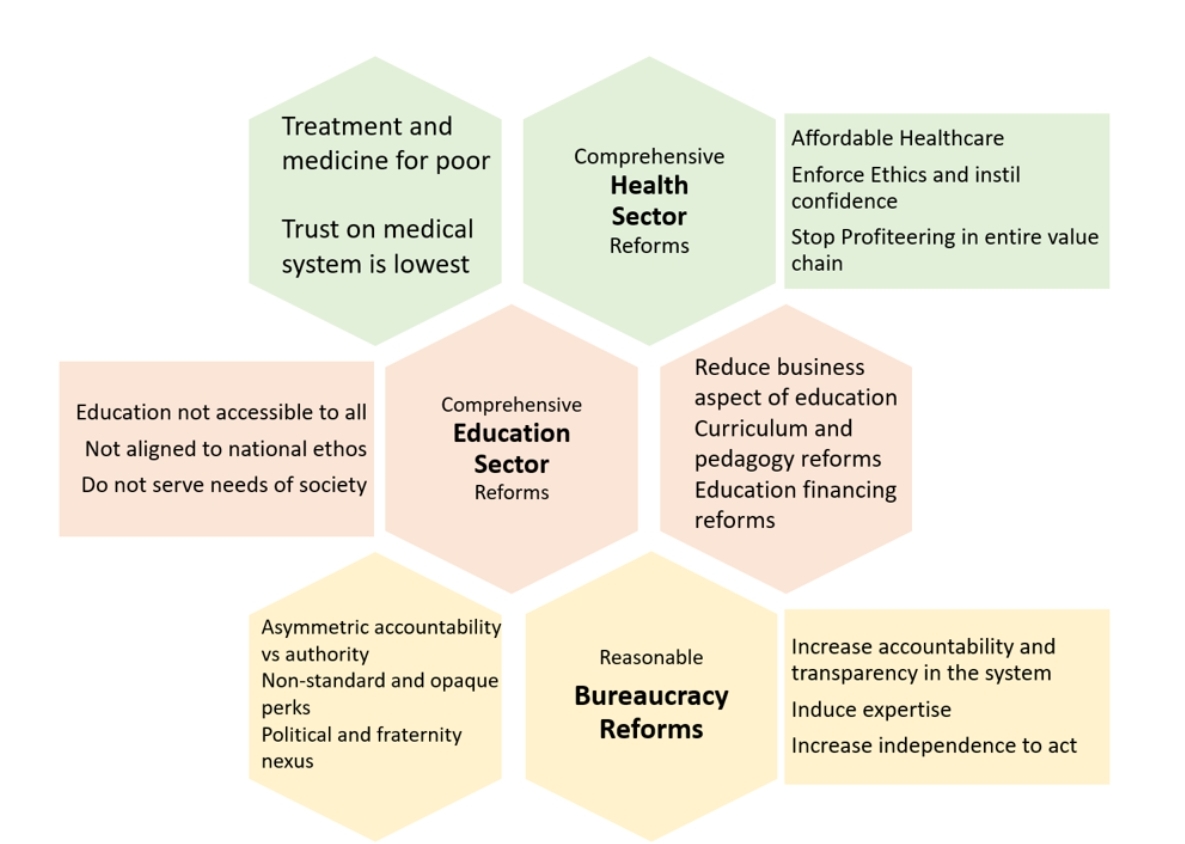
Everyone is saying, Modiji himself is saying and I strongly wish and believe that next 5 years is going to be Modi’s Swarnim kaal that will lay the foundation for Bharat in 2100. In fact, Modiji has already started planning for his next term. So this is the high time I should put my ask in front of him.┬а I have a simple three pronged ask from him. They will impact every citizen on a daily basis. they are represented in the diagram below.
The three things affect individuals on everyday basis. Fortunately food is no longer a problem for our country. But, other two basis needs – Education and Health are still elusive and that can be ensured only if the governance is aligned to the needs of citizens.┬а