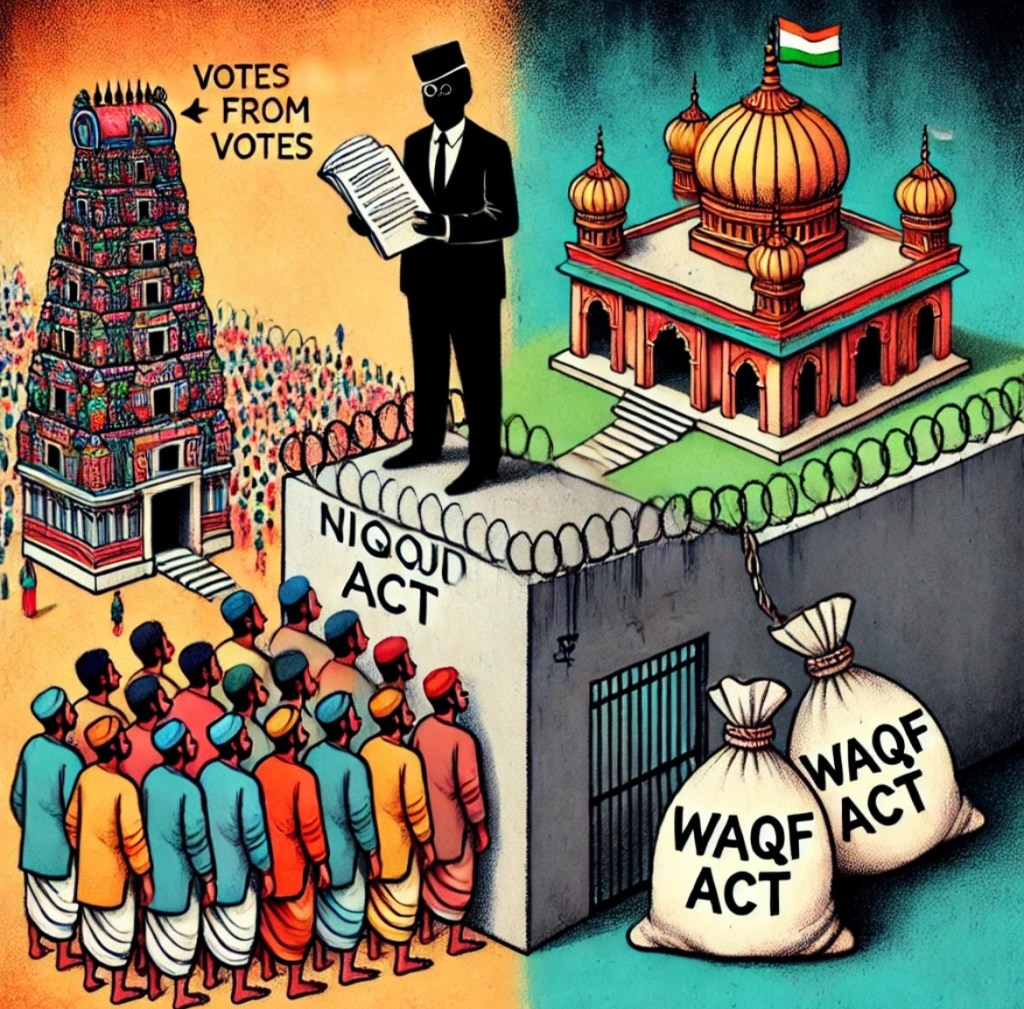
The recent decision by the BJP-led government to seemingly delay the Waqf Board Amendment Bill and the Joint Parliamentary Committee’s (JPC) expected extension of its report submission timeline is both disappointing and disheartening for many in the Hindu community. This decision is emblematic of a larger pattern that raises significant questions about BJP’s commitment to addressing the concerns and aspirations of its core Hindu support base.
BJP and Hindus: A Complex Relationship
Historically, the BJP emerged as a political force on the back of Hindu support, particularly through the Ram Janmabhoomi movement in the 1990s. At a time when the party had a negligible political presence with just two seats in the 1984 Lok Sabha elections, it was the fervent backing of Hindus that propelled the BJP into power within a decade. However, once in power, the BJP’s track record on issues central to Hindu civilizational concerns has been, at best, mixed.
The BJP’s role in supporting the Waqf Amendment Bill in 2003 and its silence during the passage of the Places of Worship Act in 1991 are stark reminders of this ambivalence. Despite being in a position to address longstanding Hindu grievances, such as unequal laws governing places of worship, the BJP has often chosen political expediency over decisive action.
The Core Issues Neglected
Over the last decade, while the BJP has succeeded in delivering on the Ram Temple promise, it has largely failed to address other pressing concerns of the Hindu community:
1. Education Reform: The Indian education system remains steeped in biases that marginalize Hindu contributions to civilization. Despite promises, the BJP has not undertaken a comprehensive overhaul of the curriculum to reflect a balanced and historically accurate perspective.
2. Temple Control: The continued state control over Hindu temples is a significant issue. While religious institutions of other communities enjoy autonomy, Hindu temples remain subject to government interference, an asymmetry that has persisted unaddressed.
3. Legal Asymmetry: There has been little effort to rectify legal imbalances that disadvantage Hindus, such as the differential application of personal laws and the lack of protections for Hindu institutions and customs.
“Sabka Saath, Sabka Vishwas”: A Double-Edged Sword
The BJP’s slogan, “Sabka Saath, Sabka Vishwas,” has sought to position the party as inclusive. However, many argue that this approach has diluted the BJP’s focus on its core constituency. Policies and rollbacks under Modi’s leadership, such as the National Population Register (NPR), farm laws, and delays in implementing the Citizenship Amendment Act (CAA), have further reinforced the perception of BJP as hesitant to act decisively on contentious issues.
This indecision has not only tarnished Modi’s image as a strong leader but also risks alienating the BJP’s core Hindu vote bank. The label of “Roll Back Modi,” arising from repeated policy reversals, has begun to erode the party’s credibility among its supporters.
Electoral Implications
These developments could have far-reaching political consequences. In states like Bihar and Delhi, where BJP faces tough competition, disillusionment among its core voters might cost the party dearly. A weakened BJP may indeed reinvigorate the Hindu vote bank, forcing the party to recalibrate its priorities and reconnect with its base.
Conclusion
The BJP’s trajectory serves as a cautionary tale for Hindus. While the party has benefited immensely from Hindu support, its governance often takes this loyalty for granted. The Hindu community must engage critically with the BJP, holding it accountable to its promises. As history shows, a strong BJP does not always equate to stronger representation for Hindu concerns. For meaningful progress, political pressure and active engagement from the Hindu electorate will be essential.
 VarnanLive
Leave a Reply